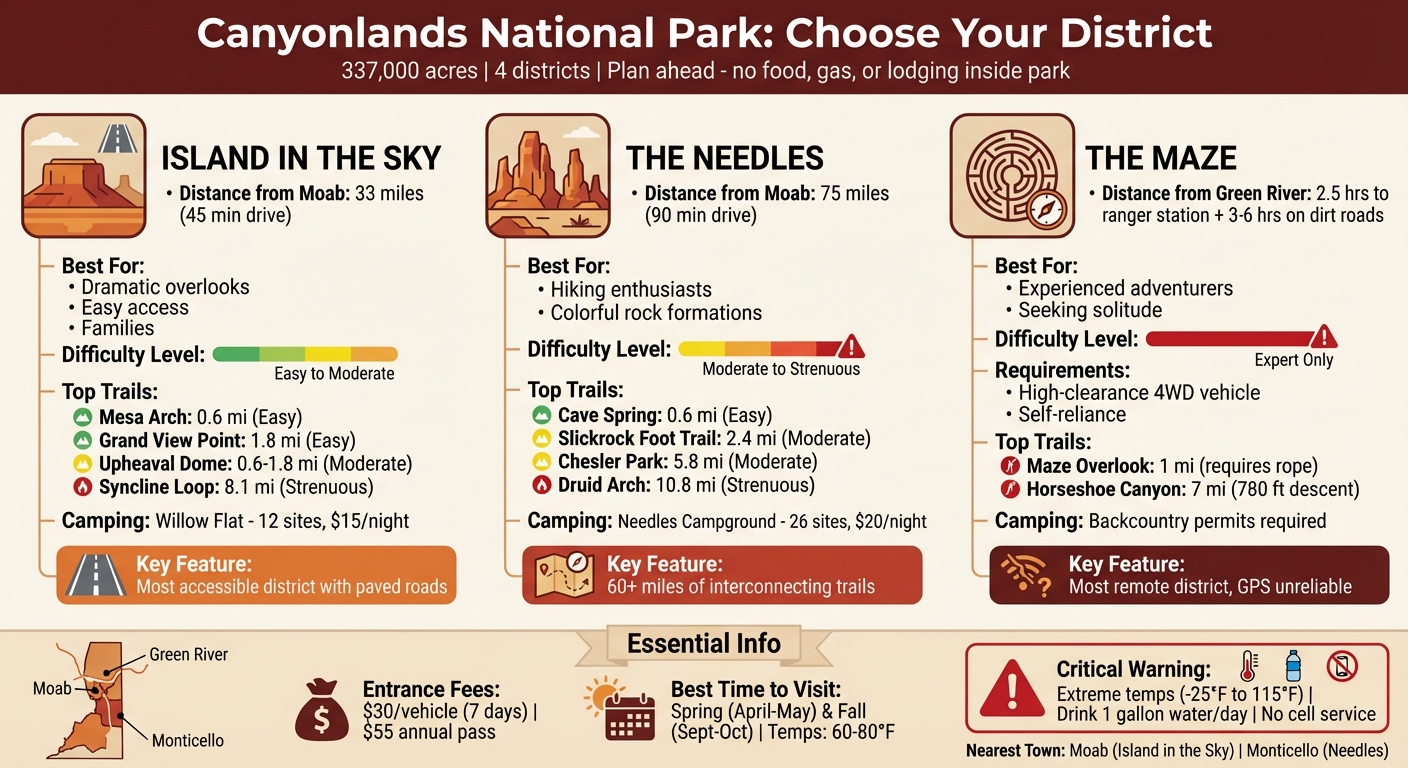
Canyonlands National Park in Utah spans over 337,000 acres of stunning desert landscapes, divided into four distinct districts: Island in the Sky, The Needles, The Maze, and the rivers. Known for its breathtaking canyons, mesas, and arches, the park is also a prime spot for stargazing, thanks to its International Dark Sky designation. However, its remote nature means no food, gas, or lodging inside the park, so preparation is essential.
Quick Highlights:
Top Activities: Iconic hikes like Mesa Arch (Island in the Sky), Druid Arch (The Needles), and the rugged Maze Overlook Trail.
Where to Stay: Nearby towns like Moab (closest to Island in the Sky) and Monticello (best for The Needles) offer lodging from budget motels to luxury glamping.
Canyonlands National Park is divided into three distinct districts, each offering its own unique adventures. The Island in the Sky district features dramatic overlooks perched atop a mesa, the Needles District is known for its colorful, interconnecting trails, and the Maze District challenges visitors with its remote and rugged terrain. Since there are no roads connecting these districts, it's best to focus your visit on just one or two areas.
Island in the Sky District
This district is famous for its breathtaking views and iconic landmarks.
Mesa Arch: A 27-foot-long natural arch perched on a cliff edge, Mesa Arch is one of the park’s most photographed spots. Arrive at least an hour before sunrise to capture the glowing orange light under the arch. It can get crowded here because it’s the ULTIMATE spot for sunrise views, but most people are very considerate to let everyone get their shots. The short, 0.6-mile round-trip hike takes about 30 minutes[8].
Grand View Point: Located at the southern tip of the mesa, this spot offers sweeping views of Monument Basin and the Colorado River canyons. The 1.8-mile round-trip trail is particularly stunning at sunset - plan to arrive an hour early to watch the light transform the landscape.
Upheaval Dome: This mile-wide crater has puzzled scientists, who debate whether it was caused by a meteor impact or a collapsing salt dome. A viewpoint is just 0.6 miles from the trailhead, but extending the hike to 1.8 miles offers a broader perspective.
Syncline Loop: Known as the park’s most difficult trail, this 8.1-mile loop is not for the faint of heart. It’s also the site of most rescues in the park. Only experienced hikers should attempt it, and they should come prepared with a map, extra water, and a flashlight.
Gooseberry Canyon: This steep trail drops 1,400 feet over 2.3 miles (4.6 miles round-trip). While several overlooks in this district are accessible by paved roads, trails like the Shafer Trail or White Rim Road require a high-clearance 4WD vehicle.
Trail Name
Distance (Round-Trip)
Difficulty
Highlights
Mesa Arch
0.6 miles
Easy
Iconic arch, sunrise views
Grand View Point
1.8 miles
Easy
Panoramic canyon vistas
Upheaval Dome
0.6 – 1.8 miles
Moderate
Geological crater
Whale Rock
0.8 – 1.0 miles
Moderate
Slickrock dome climbing
Aztec Butte
1.4 – 2.0 miles
Moderate
Ancient granaries
Syncline Loop
8.1 miles
Strenuous
Boulder fields, steep switchbacks
Gooseberry Canyon
4.6 miles
Strenuous
Steep descent to White Rim
Next, the Needles District offers a chance to explore its vibrant trails and sandstone spires.
Needles District
With over 60 miles of trails, the Needles District is a paradise for hikers. Its vibrant, banded rock formations and unique landmarks make it a must-visit for outdoor enthusiasts.
Short Trails: Family-friendly options include Roadside Ruin (0.3 miles) and Pothole Point (0.6 miles). The Cave Spring Trail (0.6 miles) features prehistoric rock art and a historic cowboy camp, but it does require climbing two ladders [9].
Chesler Park Viewpoint: This 5.8-mile round-trip hike highlights the district’s iconic sandstone spires rising from desert meadows. For a more adventurous experience, the Joint Trail takes hikers through narrow rock fractures as part of a 10.7-mile loop.
Slickrock Foot Trail: Known for its 360-degree views, this 2.4-mile trail is also the best spot in the district to spot desert bighorn sheep.
Druid Arch: One of the most spectacular hikes in the park, this 10.8-mile round-trip trail includes a steep scramble and ladder climb at the end. Starting at dawn offers the best lighting for photography.
Confluence Overlook: This 11-mile round-trip hike leads to a viewpoint 1,000 feet above the merging point of the Green and Colorado rivers. Be sure to follow cairns marking the trails and avoid moving them to ensure other hikers don’t get lost [1][7]. We recommend using the Alltrails app and downloading it for offline use.
The Maze District
For those seeking solitude and challenge, The Maze District offers unmatched remoteness. Reaching the Hans Flat Ranger Station takes about 2.5 hours from Green River, Utah, and the canyons lie another 3–6 hours beyond that, requiring a high-clearance 4WD vehicle [10]. Many visitors spend several days in this area, with trips often lasting a week.
"The Maze is the least accessible district of Canyonlands. Due to the district's remoteness and the difficulty of roads and trails, travel to the Maze requires more time." – National Park Service
Exploring The Maze requires preparation and self-reliance. GPS signals are unreliable, so topographic maps are essential. Many trails are unmarked and include steep slickrock and pour-offs that require basic climbing skills [8].
Maze Overlook Trail: Though just 1 mile round-trip, this trail demands a 25-foot rope to navigate certain sections.
Horseshoe Canyon: This 7-mile round-trip hike descends 780 feet to the Great Gallery, home to ancient pictographs. Avoid this trail in summer, as the lack of shade and extreme heat can make conditions dangerous.
Ranger Station: Open daily from 8 a.m. to 3 p.m., the station doesn’t provide food, water, or survival supplies. Carry at least 1 gallon of water per person per day, and remember that permits are required for overnight trips.
Each district in Canyonlands offers its own set of challenges and rewards, making it a destination filled with diverse adventures.
Accommodations Near Canyonlands National Park
Since there are no lodging options inside Canyonlands National Park, you'll need to plan your stay in nearby towns[12]. Moab is the main hub, located 33 miles - or about a 45-minute drive - from the Island in the Sky District. For those heading to the Needles District, Monticello offers a quieter and more affordable option, roughly 50 miles away.
Moab caters to a range of budgets and preferences. Families visiting Island in the Sky might enjoy Springhill Suites by Marriott, which boasts multiple pools, hot tubs, a splash pad, and high-speed Wi-Fi [11]. Travelers seeking luxury can opt for Hoodoo Moab, a Hilton property offering a full-service spa, outdoor pool, and on-site dining at Josie Wyatt's Grille. Outdoor enthusiasts will appreciate Field Station Moab, which is designed for hikers and bikers with features like a gear shop, map tables, bunk rooms, and communal spaces complete with fire pits.
If you're exploring the Needles District, Ulum Moab offers a luxury glamping experience with safari-style tents, king beds, rain showers, and private dipping pools on a 200-acre desert property. Budget travelers can also find affordable rooms at Comfort Suites Moab or My Place Hotel-Moab.
Lodges in Moab
Moab's proximity to the Island in the Sky District makes it the most convenient base for exploring this area. Springhill Suites is just 35 minutes from the Island in the Sky Visitor Center, while Under Canvas Moab offers a glamping experience 22 miles from the park entrance. For a mix of convenience and amenities, the Aarchway Inn provides a complimentary in-town shuttle, a BBQ pit, an espresso bar, and stunning canyon views. Plus, it's only 2 miles from Arches National Park, making it a great option for visitors planning to explore both parks.
For those who prefer to stay downtown, options like The Gonzo Inn and the Hampton Inn offer easy access to Moab's restaurants and shops. If you're looking for a more secluded retreat, Sorrel River Ranch Resort spans 160 acres and is perfect for extended stays. Keep in mind that prices in Moab tend to rise during peak seasons - late March through June and early September to mid-October - so booking in advance is highly recommended.
For a rustic alternative, several campgrounds provide easy access to the park's districts.
Campgrounds in Island in the Sky District
Even though the park is remote, Willow Flat Campground offers basic comforts while preserving a wilderness atmosphere. This is the only developed campground in the Island in the Sky District, featuring 12 first-come, first-served sites[14]. Amenities include vault toilets, fire rings, picnic tables, and trash collection, but no water is available on-site. Campers should fill up at the visitor center (open spring through fall) or bring their own supply[14]. RVs up to 28 feet are allowed, and there's an amphitheater for ranger-led programs[14].
The campground fills up quickly during peak seasons (late March through June and early September to mid-October), so arriving early in the day is crucial[14]. For those seeking more amenities like showers, Wi-Fi, or hookups, Sun Outdoors Canyonlands Gateway near Moab offers full-service camping. Note that reservations require a deposit of two nights or half the stay for bookings under 30 nights.
Campgrounds in Needles District
In keeping with the park's limited services, The Needles Campground provides 26 individual sites, including 5 tent-only options[14]. Some sites can be reserved during the spring and fall, while others are first-come, first-served. The campground includes toilets, seasonal potable water, fire rings, picnic tables, trash collection, and an amphitheater. As with Willow Flat, RVs up to 28 feet are permitted.
For larger groups, the Needles District features three designated group campsites: Squaw Flat (up to 50 people and 10 vehicles), Wooden Shoe, and Split Top, each accommodating between 15 and 50 people. If you're looking for a more comfortable option outside the park, Glamping Canyonlands near the Needles District offers stylish accommodations [15]. Its location near major trails makes it a great base for multi-day hiking adventures in this scenic area.
Dining Options Near Canyonlands National Park
Canyonlands National Park doesn’t have any restaurants or general stores inside its boundaries[12]. That means you’ll need to plan ahead for meals. Moab, the closest town to the Island in the Sky District, is about a 40-minute drive away. For those exploring the Needles District, Monticello is a shorter trip, while visitors heading to The Maze may find Green River or Hanksville more convenient.
Given the park’s remote location, a packed cooler with sandwiches, snacks, and plenty of water is a smart move. Moab’s City Market is a handy spot to stock up, offering a bakery, deli, and even the town’s only Starbucks. Quick grab-and-go options are also available at Maverik and Chevron gas stations, which carry sandwiches and burritos. If you’re dealing with dietary restrictions, Walker Drug and General Store in Moab has a variety of organic and alternative health products.
Here’s a closer look at dining options in Moab and picnic areas within the park.
Restaurants in Moab
Moab’s dining scene caters to everyone, from casual hikers to those looking for a more refined meal. For a laid-back vibe, Moab Brewery, Moab Diner, and Pasta Jay’s welcome diners in their trail gear. Craving Mexican food? Fiesta Mexicana is a local favorite. If you’re in the mood for variety, Zax offers an all-you-can-eat buffet, while 98 Center provides a quieter, more relaxed atmosphere.
For upscale dining, check out Desert Bistro and Sunset Grill, where entrees range from $25 to $40 or more. The Sunset Grill, Moab’s oldest running restaurant, has been serving guests since 1993 and is located in the former home of "Uranium King" Charlie Steen [22]. They even offer a free shuttle service to and from local motels, RV parks, and B&Bs [22]. Make reservations early, especially for places like Desert Bistro, which fills up fast. Keep in mind that many restaurants operate seasonally, so check their websites for winter hours.
For those with dietary restrictions, Love Muffin Cafe serves vegan muffins and gluten-free breakfast burritos. Eddie McStiffs features options like "The Vegan" pizza and Miso Tofu Wraps. Meanwhile, Milt’s Stop and Eat, a Moab institution, offers vegetarian-friendly dishes made with locally sourced, grass-fed ingredients. If you’re planning to enjoy an alcoholic beverage, note that Utah’s liquor laws limit grocery stores to selling beer with 5% ABV or less. Stronger drinks are only available at State Liquor stores, which are closed on Sundays and holidays.
Picnic Spots in the Park
If you’d rather enjoy your meal outdoors, Canyonlands has some great picnic spots. Both Willow Flat in the Island in the Sky District and The Needles Campground have picnic tables, fire rings, and vault toilets [14]. However, potable water isn’t available at Willow Flat, so you’ll need to fill up at the Island in the Sky Visitor Center during spring through fall [25]. At The Needles Campground, seasonal potable water is available, and the Needles Visitor Center has water year-round.
"Canyonlands is an isolated and rugged environment. You won't find many services here; it's best to bring what you'll need for your visit." – National Park Service [25]
With temperatures ranging from -25°F to 115°F and only 8 inches of precipitation annually, staying hydrated is critical. Rangers recommend drinking at least 1 gallon of water per day to avoid dehydration [1]. Be sure to pack out all trash to help preserve the delicate desert ecosystem. If you need any last-minute supplies, the Needles Outpost, located just outside the park entrance, has a seasonal general store and fuel.
How to Get to Canyonlands and Travel Tips
Driving Directions and Park Access
Canyonlands National Park sits in Utah's high desert, so getting there takes a bit of planning. The park is divided into four districts - Island in the Sky, The Needles, The Maze, and the Rivers - and none of them are connected by roads or bridges. Driving between districts can take anywhere from 2 to 6 hours [28][29].
Island in the Sky is the most accessible district, located about 33 miles from Moab. To get there, drive north on US‑191 for roughly 10 miles, then turn onto UT‑313 and continue for about 23 miles. The trip takes around 40 minutes[4]. The Needles, on the other hand, is farther south - roughly 75 miles from Moab. From Moab, head south on US‑191, then turn west onto UT‑211 and drive another 35 miles to reach the entrance. This drive takes about 90 minutes. Be aware: "Needles Overlook Road" won't lead you into the park, so avoid it.
The Maze is the most remote and challenging district to access. From the Hans Flat Ranger Station, you'll need to drive 46 miles on dirt roads, which require a high-clearance 4WD vehicle. Note that ATVs, UTVs, and OHVs are not allowed on any park roads [4][28]. Additionally, RVs over 25 feet in length face parking restrictions at some overlooks in Island in the Sky and The Needles [29][30].
The closest airport is Canyonlands Field (CNY), just 16 miles from Moab. Other options include Grand Junction Regional Airport, located 113 miles away, and Salt Lake City International Airport, which is about 240 miles away depending on the district you're visiting. Since there’s no public transportation to or within the park, renting a car is a must. Alternatively, commercial van and shuttle services are available between Moab and both Salt Lake City and Grand Junction.
With your route set, here’s how to make your visit both safe and enjoyable.
Travel Tips for Visitors
Once you’ve planned your trip, keep these practical tips in mind. Entrance fees are $30 per vehicle, $25 for motorcycles, and $15 per person for pedestrians or bicyclists. These fees cover a 7-day visit. For frequent visitors, an annual pass is available for $55 [4]. The park itself is open 24/7 year-round, but visitor center hours vary by season. For instance, the Island in the Sky Visitor Center operates from 8:00 AM to 5:00 PM most of the year but shifts to 9:00 AM to 4:00 PM in winter. Meanwhile, The Needles Visitor Center closes entirely from mid-December to mid-February.
Weather plays a big role in planning your visit. Temperatures can swing from a frigid –25°F to a scorching 115°F, with only about 8 inches of rain annually. Spring (April–May) and fall (mid-September–October) are the most comfortable times to visit, with daytime temperatures typically ranging from 60°F to 80°F. Summer heat often exceeds 100°F, so avoid strenuous activities between 10:00 AM and 4:00 PM during those months [32]. To stay safe, drink at least 1 gallon of water per person daily [1].
Cell service is almost nonexistent in most areas, particularly in The Needles and the backcountry [4][32]. Download the NPS App and print maps ahead of time, as GPS can be unreliable. If you’re visiting in late summer, be prepared for monsoon conditions, which can cause sudden flash floods. If you notice rushing water or debris, head to higher ground immediately - even if the skies look clear. For safety, always maintain a distance of at least 150 feet from large animals and 75 feet from smaller ones like snakes. Lastly, permits are required for all overnight backcountry trips, river trips, and for driving or biking the White Rim Trail.
Conclusion
Canyonlands National Park offers something for everyone, whether you're a casual visitor or a seasoned adventurer. The Island in the Sky District is perfect for those looking for easy access to breathtaking views, with highlights like Mesa Arch and Grand View Point. If you're up for a hiking challenge, the Needles District features stunning sandstone formations and trails such as the Chesler Park Loop. For anyone craving true isolation, the Maze District provides a rugged wilderness experience - but you'll need a high-clearance 4WD vehicle and plenty of supplies to navigate this remote area. Planning ahead is key to making the most of your trip.
Since there are no lodging or dining options within the park, Moab is the go-to spot for hotels, restaurants, and supplies. If you're visiting the Needles District, Monticello offers accommodations closer to that area. For those who prefer camping, Willow Flat in Island in the Sky and the Needles Campground are available, with the latter offering reservations during the popular spring and fall seasons.
Even with around 820,000 visitors expected in 2024, Canyonlands remains a place where you can find plenty of room to roam. The $30 entrance fee covers seven days, giving you enough time to explore multiple districts. To truly appreciate the park, plan for at least one full day in each district you wish to visit.
FAQs
When is the best time to visit Canyonlands National Park?
The ideal times to visit Canyonlands National Park are in spring (March to May) and fall (September to November). During these months, the weather is mild and comfortable, making activities like hiking and sightseeing much more enjoyable.
In contrast, summer temperatures can soar above 100°F, creating challenging conditions for outdoor exploration. Winters, on the other hand, can be quite cold, with temperatures sometimes dipping into the teens or even lower. By choosing spring or fall, you can avoid these extremes and fully appreciate the park's breathtaking scenery in more manageable conditions.
Are there places to eat inside Canyonlands National Park?
Canyonlands National Park doesn’t have any restaurants or food services available inside the park itself. If you’re planning a visit, it’s essential to pack your own meals and snacks - especially if you’ll be out exploring for the day.
For dining options outside the park, nearby towns such as Moab, Monticello, and Green River have plenty to offer. You’ll find a range of restaurants, cafes, and grocery stores to match different preferences and budgets.
What are the accommodation options near Canyonlands National Park?
While Canyonlands National Park doesn't have lodging or dining options within its boundaries, nearby towns like Moab, Monticello, and Green River provide plenty of choices. Whether you're looking for hotels, motels, vacation rentals, or campgrounds, these towns serve as convenient bases for your park adventures.
If camping is more your style, the park offers backcountry camping at designated sites. Just make sure to plan ahead - check for required permits and guidelines to ensure a smooth and enjoyable experience.